I know I said I was going to make June the month of patisserie mastery. My goal hasn’t changed. But I found this recipe I wanted to try, and so…But. In the future I really need to remember several things about the beauty of recipes…
First, always always always remember to read the recipe first. In its entirety. Without skimming. You should be able to calculate how much prep time you need and how much time the final product will take to turn out. It really is awful to be mid-recipe and realize there is chilling time or cooling time you didn’t account for, or that your ingredients were supposed to be kept cold, or left to soften to room temperature.
Second, always check to be sure you have all of your ingreidents on hand, and also measured out. This can be super important. The French call this mise en place, and it is handy for a variety of reasons — you will know immediately instead of halfway through the recipe if you’re missing anything or short on something so you can go to the store to restock prior to starting, and you also will have everything assembled and ready for those moments when things come together super fast and you don’t have any time to actually stop and measure!
Third as a point — if the first part of this post wasn’t a good enough hint to have everything ready because, of course!, you’ve read the entire recipe (several times, just to be sure), for THIS recipe in particular it is more than a good idea to have your ingredients handy and ready to go. You’re making a simple shortbread. And then you’re making caramel. And caramel is hot. [I mean…HOT! The kind of hot that, no matter how tempting and delicious it looks once it comes up to temperature, you should NOT try it at that time! Ask me how I know…I swear my tongue still has one section that’s not experiencing the joy of food because it is still numb…] The shortbread has to have time to bake. The caramel has to be ready to pour on the cooled shortbread. There is a fine line in that timetable.
Finally, no matter how many times you have melted chocolate for various recipes, a best practice is to follow the exact instructions in the recipe you’re making. Because chances are there is a particular way it “should” be done to achieve the correct texture you want. Melting chocolate for a ganache is very different than melting chocolate to make confections like chocolate-covered Oreos, and both methods are not necessarily the same as what one might use to make a chocolate bar. A ganache chocolate can have a consistency that is softer, or thick, and moldable. You can use it to fill a truffle or frost a cake or layer in between macarons. A dipping chocolate has to be the consistency that’s thin enough to coat the product being coated. A chocolate bar should have a consistency that snaps with a crispness.
My advice when making a recipe that is new is always to follow it to the “t” the first time. You should see what the creator intended the recipe to be — the appearance, scent, texture, taste. After that initial time, if you think you want to experiment, then by all means — absolutely make it your own.
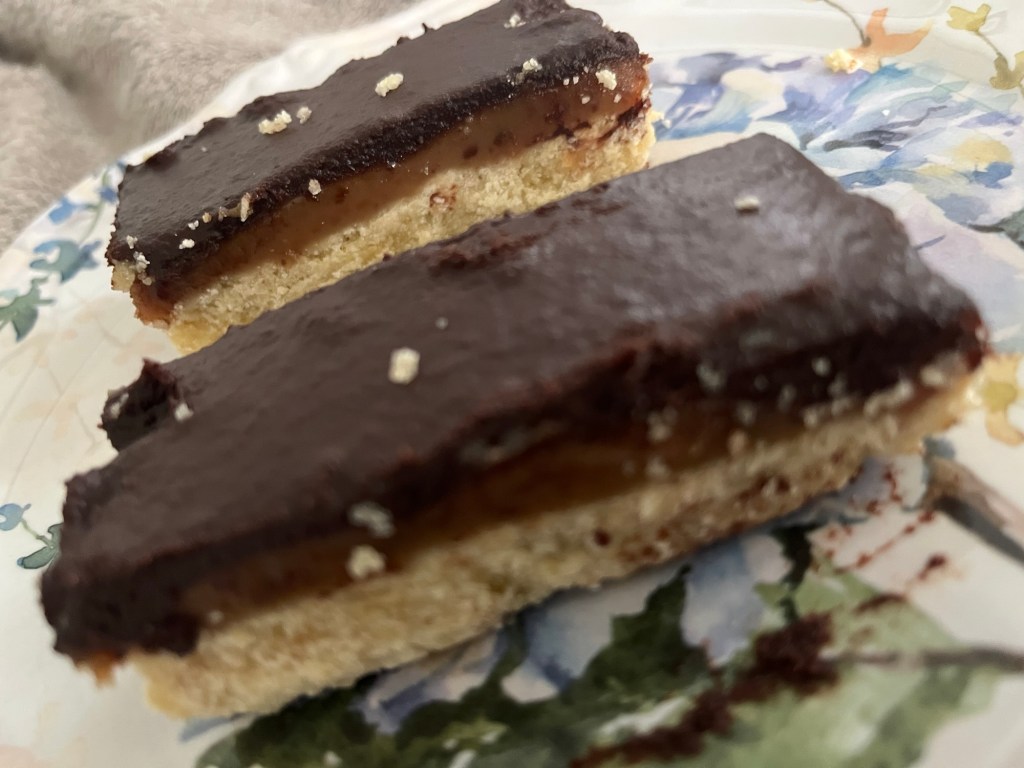
I’ve done Millionaire Bars twice. The first time was a disaster. I think I (foolishly, for someone who bakes often and should absolutely know better) committed every error listed above. The second time I followed my own advice and the results were much better!
https://www.tasteofhome.com/recipes/millionaire-shortbread-bars/#RecipeCard
I hope you give these a try, especially if you enjoy something akin to a Twix bar. The effort of making the caramel instead of melting the store-bought prepackaged ones is sooo worth it! (Just heed my advice and do NOT attempt to lick the spoon once you’ve poured it onto the shortbread!).
And because you’ll be working with very hot caramel (in case you missed the first warning or two…), maybe save this one for a rainy day. Literally. If the sun is beating into your kitchen and you lack air conditioning (as I do, though my husband has been at his HVAC job for almost 32 years…), you might not want to be sweating over a hot oven and then also standing in close proximity to a hot stove. But these are worth the effort when the temperatures are cooler. So…what are you going to play with in your kitchen?!

 Come Play In The Kitchen!
Leave a comment